

Fundamentals of Microwave, mmWave, and Massive MIMO
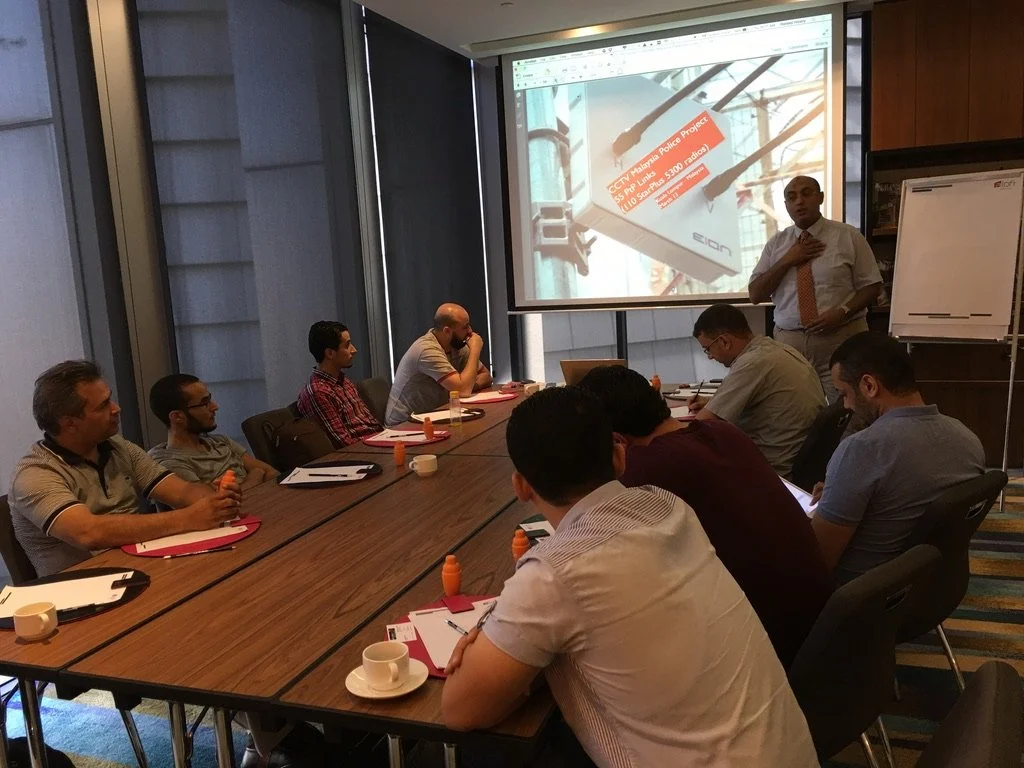
5-day training event
6100-3110
Microwave, mmWave, and Massive MIMO fundamentals center on how electromagnetic waves are generated, propagated, and manipulated to maximize wireless capacity and coverage: microwave frequencies (roughly 1–30 GHz) offer robust propagation and penetration for wide-area and backhaul links; mmWave bands (roughly 24–100 GHz) provide very large contiguous bandwidths enabling multi-gigabit throughput but require highly directional antennas and suffer greater path loss and susceptibility to blockage; Massive MIMO leverages large antenna arrays and advanced beamforming algorithms to spatially multiplex many users simultaneously, increasing spectral efficiency while mitigating interference and compensating for higher-frequency impairments through beam steering, channel estimation, and precoding; together these technologies demand careful system design—including antenna array geometry, RF front-end linearity, channel modeling, and link-adaptation strategies—to balance trade-offs among coverage, capacity, latency, and hardware complexity in next-generation wireless networks.
Course Outlines
Fundamentals of Microwave, mmWave, and Massive MIMO
Course overview
Target audience: RF engineers, wireless systems engineers, graduate students, technical managers
Course goals:
Provide core theoretical foundations of microwave and mmWave propagation and components
Explain system-level design principles for mmWave links and 5G/6G use cases
Introduce Massive MIMO concepts, channel modelling, signal processing, and practical implementation challenges
Equip participants to evaluate trade-offs and design components and subsystems for high-frequency wireless systems
Module 1 — Fundamental Electromagnetics for Microwave and mmWave
Objectives:
Refresh Maxwell’s equations and wave solutions relevant to guided and radiated propagation
Highlight frequency-dependent phenomena and scaling laws
Topics:
Maxwell’s equations and boundary conditions (brief review)
Plane waves, wave polarization, wave impedance
Wave propagation in homogeneous and layered media
Skin effect, conductor and dielectric losses, frequency scaling
Near-field vs far-field regions; Fraunhofer and Fresnel zones
Module 2 — Microwave Components and Network Theory
Objectives:
Understand common microwave building blocks and S-parameter network analysis
Topics:
Transmission line theory and distributed circuit models
S-parameters: measurement, interpretation, and cascaded networks
Matching networks, Smith chart techniques
Passive components: couplers, filters, hybrids, attenuators
Active components: low-noise amplifiers, mixers, power amplifiers — linearity and noise considerations
Module 3 — Antenna Theory and Array Fundamentals
Objectives:
Cover single-element antenna behavior and the basics of array theory
Topics:
Antenna parameters: gain, directivity, efficiency, bandwidth, polarization
Antenna types for mmWave: patch, slot, dipole, horn, lens antennas
Array factor, beamforming basics, grating lobes, element spacing
Mutual coupling effects and their impact on pattern and impedance
Beam steering hardware: phase shifters, true time delay vs phase control
Module 4 — mmWave Propagation and Channel Modeling
Objectives:
Present propagation characteristics specific to mmWave bands and modeling approaches
Topics:
Path loss models: free-space, empirical (CI, FI), and site-specific models
Penetration, diffraction, scattering, and reflection at mmWave frequencies
Atmospheric absorption, rain/foliage effects, blockage (human, vehicle)
Small-scale fading, delay spread, angular spread
Stochastic and deterministic channel models: 3GPP, NYU, QuaDRiGa, ray tracing basics
Module 5 — Link Budget, System Design, and RF Chain Considerations
Objectives:
Teach end-to-end link budgeting and practical system trade-offs for mmWave links
Topics:
Link budget components: transmitter, path loss, antenna gains, receiver sensitivity, noise figure
Dynamic range, EIRP constraints, regulatory considerations
Duplexing options: TDD vs FDD at mmWave
Front-end architectures: hybrid beamforming, fully digital, analog beamforming
RF impairments: phase noise, I/Q imbalance, nonlinearity, calibration requirements
Module 6 — Massive MIMO Principles
Objectives:
Introduce the concepts and theoretical foundations of Massive MIMO
Topics:
Multiuser MIMO fundamentals and capacity scaling laws
Channel state information (CSI): acquisition, reciprocity, pilot design, pilot contamination
Linear precoding and combining: MRT, ZF, MMSE
Spatial multiplexing gains, degrees of freedom, and asymptotic behaviour
Hardware scaling, cost/complexity trade-offs
5-day training event
6100-3110
Microwave, mmWave, and Massive MIMO fundamentals center on how electromagnetic waves are generated, propagated, and manipulated to maximize wireless capacity and coverage: microwave frequencies (roughly 1–30 GHz) offer robust propagation and penetration for wide-area and backhaul links; mmWave bands (roughly 24–100 GHz) provide very large contiguous bandwidths enabling multi-gigabit throughput but require highly directional antennas and suffer greater path loss and susceptibility to blockage; Massive MIMO leverages large antenna arrays and advanced beamforming algorithms to spatially multiplex many users simultaneously, increasing spectral efficiency while mitigating interference and compensating for higher-frequency impairments through beam steering, channel estimation, and precoding; together these technologies demand careful system design—including antenna array geometry, RF front-end linearity, channel modeling, and link-adaptation strategies—to balance trade-offs among coverage, capacity, latency, and hardware complexity in next-generation wireless networks.
Course Outlines
Fundamentals of Microwave, mmWave, and Massive MIMO
Course overview
Target audience: RF engineers, wireless systems engineers, graduate students, technical managers
Course goals:
Provide core theoretical foundations of microwave and mmWave propagation and components
Explain system-level design principles for mmWave links and 5G/6G use cases
Introduce Massive MIMO concepts, channel modelling, signal processing, and practical implementation challenges
Equip participants to evaluate trade-offs and design components and subsystems for high-frequency wireless systems
Module 1 — Fundamental Electromagnetics for Microwave and mmWave
Objectives:
Refresh Maxwell’s equations and wave solutions relevant to guided and radiated propagation
Highlight frequency-dependent phenomena and scaling laws
Topics:
Maxwell’s equations and boundary conditions (brief review)
Plane waves, wave polarization, wave impedance
Wave propagation in homogeneous and layered media
Skin effect, conductor and dielectric losses, frequency scaling
Near-field vs far-field regions; Fraunhofer and Fresnel zones
Module 2 — Microwave Components and Network Theory
Objectives:
Understand common microwave building blocks and S-parameter network analysis
Topics:
Transmission line theory and distributed circuit models
S-parameters: measurement, interpretation, and cascaded networks
Matching networks, Smith chart techniques
Passive components: couplers, filters, hybrids, attenuators
Active components: low-noise amplifiers, mixers, power amplifiers — linearity and noise considerations
Module 3 — Antenna Theory and Array Fundamentals
Objectives:
Cover single-element antenna behavior and the basics of array theory
Topics:
Antenna parameters: gain, directivity, efficiency, bandwidth, polarization
Antenna types for mmWave: patch, slot, dipole, horn, lens antennas
Array factor, beamforming basics, grating lobes, element spacing
Mutual coupling effects and their impact on pattern and impedance
Beam steering hardware: phase shifters, true time delay vs phase control
Module 4 — mmWave Propagation and Channel Modeling
Objectives:
Present propagation characteristics specific to mmWave bands and modeling approaches
Topics:
Path loss models: free-space, empirical (CI, FI), and site-specific models
Penetration, diffraction, scattering, and reflection at mmWave frequencies
Atmospheric absorption, rain/foliage effects, blockage (human, vehicle)
Small-scale fading, delay spread, angular spread
Stochastic and deterministic channel models: 3GPP, NYU, QuaDRiGa, ray tracing basics
Module 5 — Link Budget, System Design, and RF Chain Considerations
Objectives:
Teach end-to-end link budgeting and practical system trade-offs for mmWave links
Topics:
Link budget components: transmitter, path loss, antenna gains, receiver sensitivity, noise figure
Dynamic range, EIRP constraints, regulatory considerations
Duplexing options: TDD vs FDD at mmWave
Front-end architectures: hybrid beamforming, fully digital, analog beamforming
RF impairments: phase noise, I/Q imbalance, nonlinearity, calibration requirements
Module 6 — Massive MIMO Principles
Objectives:
Introduce the concepts and theoretical foundations of Massive MIMO
Topics:
Multiuser MIMO fundamentals and capacity scaling laws
Channel state information (CSI): acquisition, reciprocity, pilot design, pilot contamination
Linear precoding and combining: MRT, ZF, MMSE
Spatial multiplexing gains, degrees of freedom, and asymptotic behaviour
Hardware scaling, cost/complexity trade-offs